Real-time AI sales coaching that puts your best closer on every call.
Phos Sales Assistant is a real-time AI sales coaching tool that listens to a live call and hands every rep the move your top closer would make, in under a second.


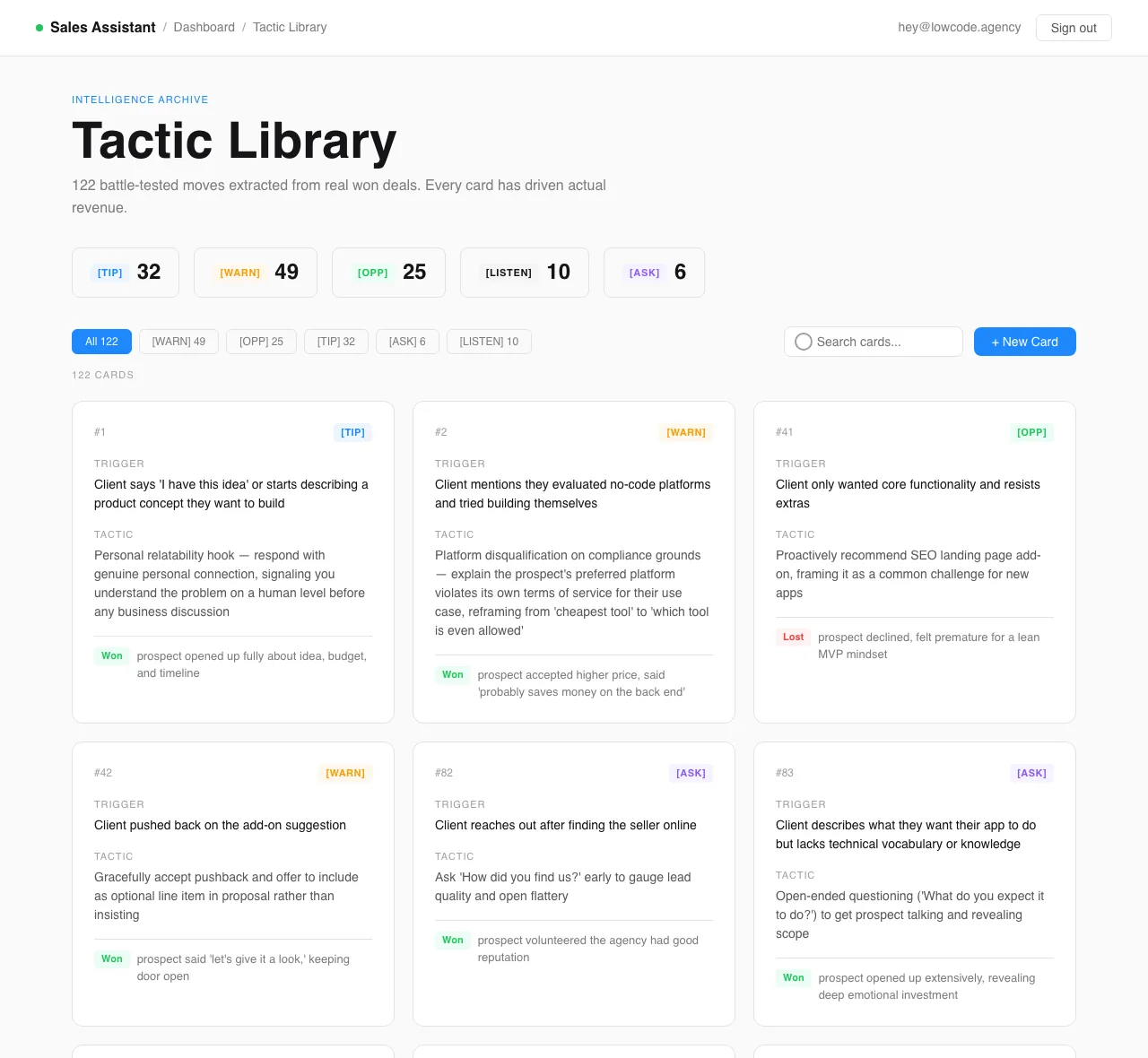
Phos Sales Assistant is a real-time AI sales coaching tool that listens to a live call and shows the rep the move a top closer would make, in under a second. Instead of the winning line arriving forty minutes after the call ends, it appears on the rep's screen while the prospect is still talking, drawn from a tactic library built on your own closed-won calls.
Why do sales reps miss the right response during a live call?
Reps recognize the winning response minutes after the call ends. By then it's useless, because the pattern lives in one top closer's head and never reaches the rest of the team's screen.
The line lands flat
The prospect raises the objection. The rep's brain scrambles. The line lands flat.
Forty minutes too late
Later, in the car, the perfect answer shows up. Too late to matter.
It's a rep-count problem
A senior closer has heard the objection hundreds of times, so the pattern fires early. That pattern rarely leaves one person's head.
How can AI help every rep sell like your best closer?
Phos Sales Assistant listens to the call live and shows each rep the same move a top closer would make, in under a second.
The overlay sits outside the screen-share frame. The prospect sees the call. The rep sees the call, and the move.
Two panels sit on the rep's screen. One streams the tactic cards: what to say the moment it matters. The other holds a live agenda, your own sales rubric, checking off each step so nothing gets skipped.
Your best closer's instinct, on every rep's screen, on every call.
Built for the founder or COO running a serious business, typically $5M+ in revenue. It lands hardest on teams ramping new sales hires, where a new rep needs your process in front of them from call one.
What does an AI sales assistant detect during a live call?
Phos Sales Assistant classifies five signal types as the prospect speaks: objection forming, buying signal, tactical cue, missed question, and rep over-talking.
Objection forming
When the prospect starts to push back, the card surfaces the line that softens the moment.
Buying signal
When the prospect asks about timeline or names a decision-maker, the card cues the next step.
Tactical adjustment
The card mirrors the prospect's language, re-anchors the price, or surfaces the right proof point.
Missed question
When the conversation drifts from a qualifying point, the card hands back the question that pulls it back.
Talk less
When the rep talks too long mid-objection, the card signals to stop and give the prospect room.
Read at a glance
Each signal fires its own card, so a rep reads it in the half-second they have while the prospect is still speaking.
See Phos Sales Assistant fire on a live call.
A short look at the overlay in action: the prospect speaking, the signal classified in real time, and the tactic card surfacing on the rep's screen while there's still time to use it.
The card the rep sees, and the normal call the prospect sees.
How does an AI sales assistant work during a live call?
The app detects the call, the rep starts it with one click, and the model classifies each statement and renders a card in under a second, visible only to the rep.
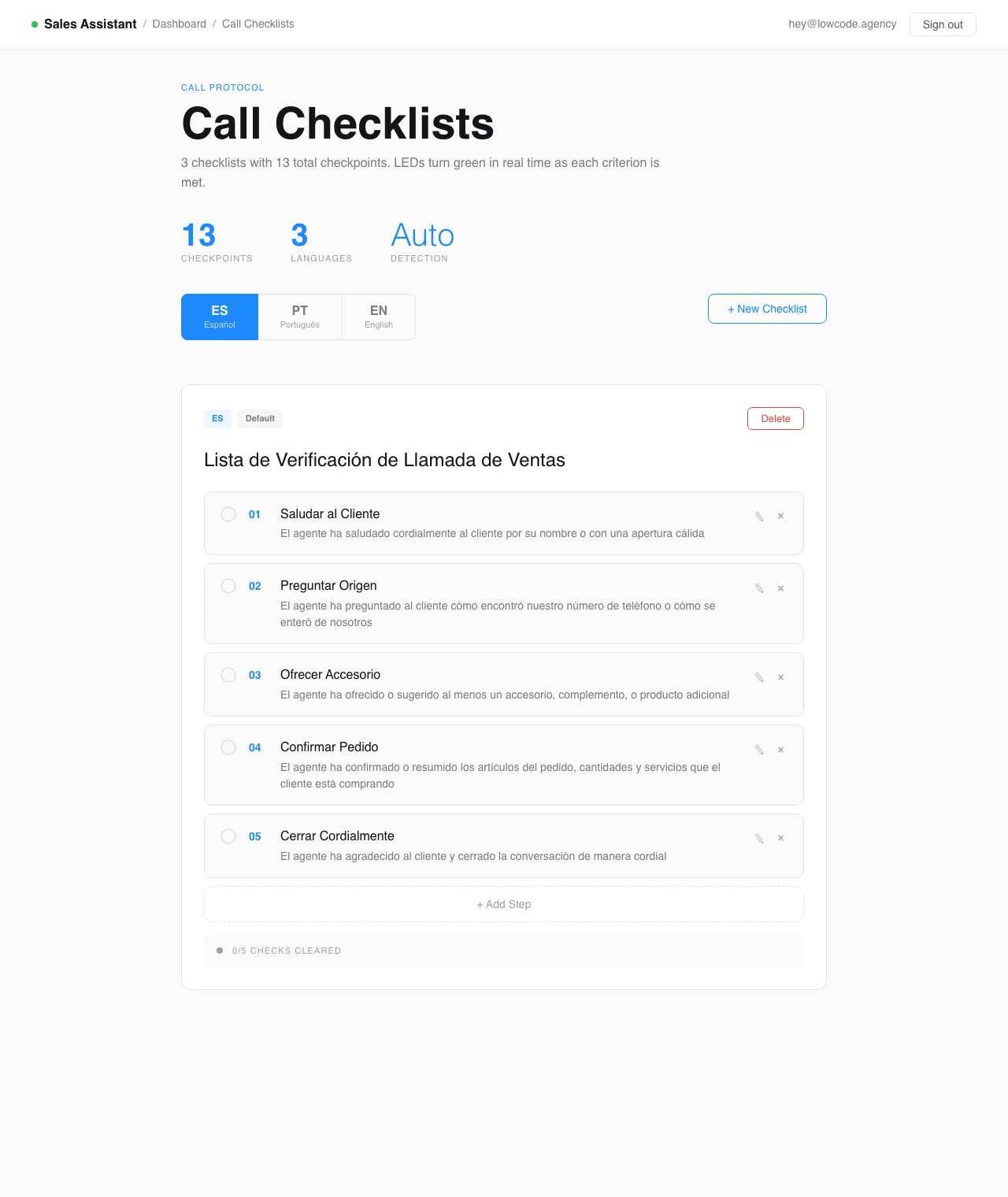
- The desktop app detects when a call starts and prompts the rep. One click begins the session. No bot joins the meeting and no recording notice appears on the prospect's screen.
- One agent transcribes the call live while a second classifies each statement, while the sentence is still landing.
- That classification matches against a tactic library held in a fast local database, calibrated to the way your team sells.
- A card renders on the rep's screen, and the live agenda checks off each step. The prospect never sees either.
What makes this different from a generic AI note-taker?
It fires mid-call, it's trained on your own wins, it shows you who is ramping, and it sharpens every month.
It fires mid-call
The tactic surfaces while the deal is still live, in time for the rep to use it, instead of showing up in a summary after the call ends.
Built on your own wins
The library trains on your closed-won calls, so the moves match your buyers, your deals, and your objections.
It shows you who is ramping
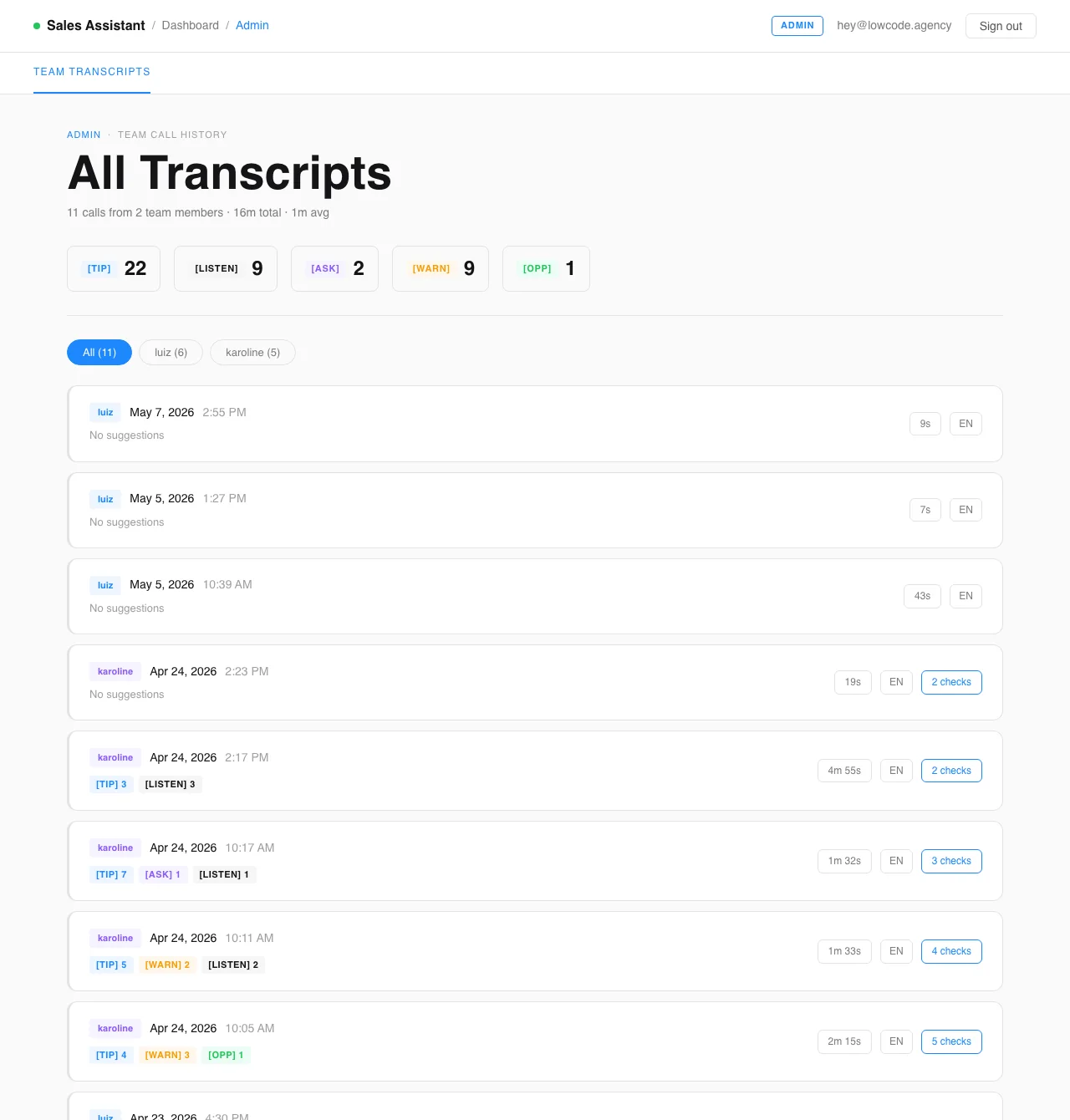
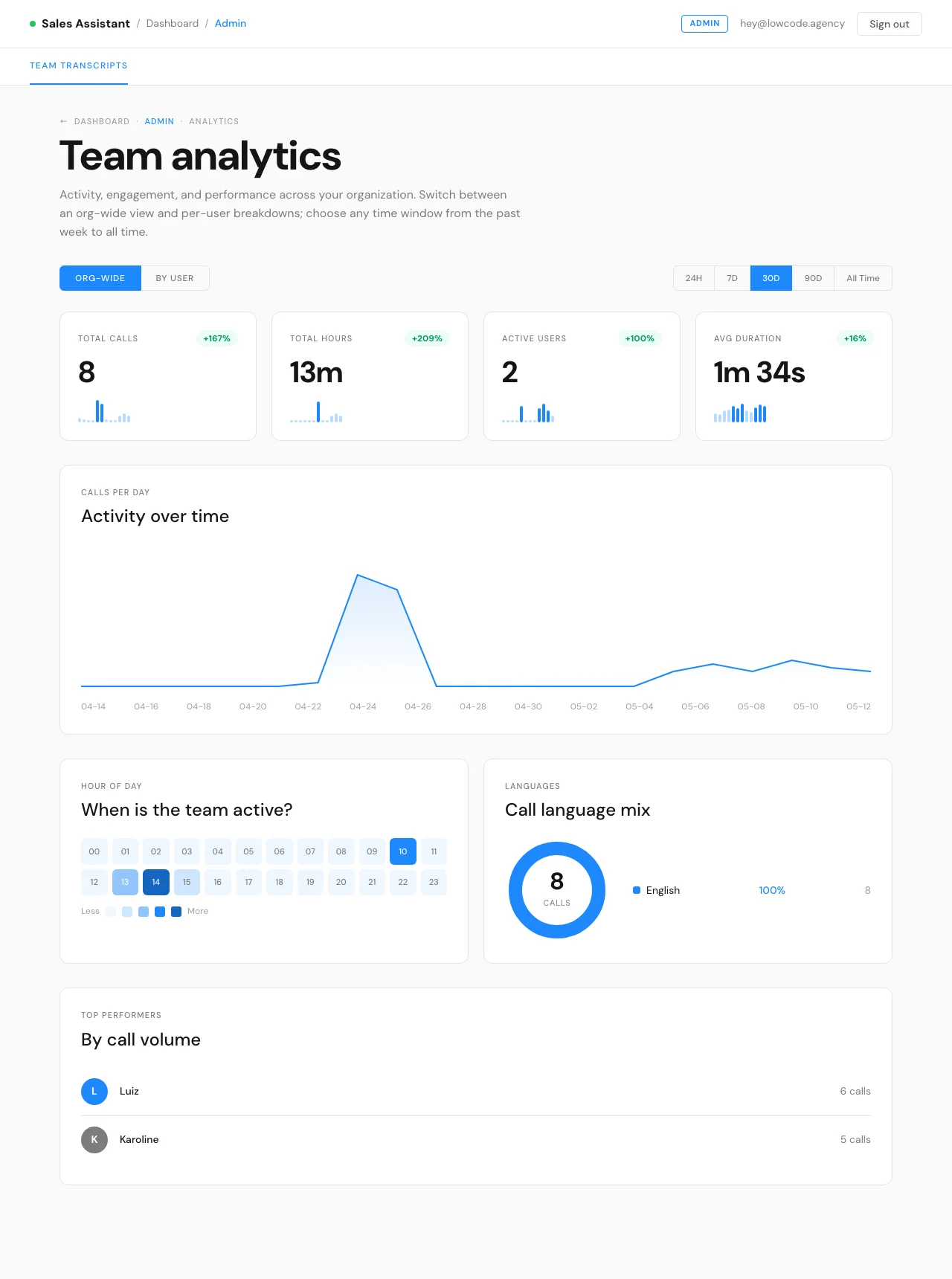
Every call is scored against your rubric, so you can see which new hire is on track and where a rep keeps missing the same point.
It sharpens every month
A monthly review reads every transcript, surfaces the questions your cards don't cover yet, and turns them into new cards.
Which industries get the most from real-time AI sales coaching?
Industries where deal size justifies a senior closer's judgment on every call: manufacturing, distribution, professional services, healthcare, real estate, and founder-led teams scaling past the founder.
Manufacturing & Distribution
Long cycles and technical buyers, with a rep bench strong on product knowledge but new to objection handling at this deal size.
Professional Services, Engineering & Agencies
Multi-stakeholder deals where the technical buyer and the economic buyer need two different moves in the same call.
Healthcare & Real Estate
Pricing conversations that soften in the room. The tactic library holds the anchor when a rep's instinct is to discount.
Founder-led teams ramping new reps
The founder brings in most of the revenue and closes intuitively. This puts the founder's process on every rep's screen from call one, so they ramp in weeks instead of quarters.
What conferencing tools and CRMs does Phos Sales Assistant support?
Zoom, Google Meet, and Microsoft Teams, on native Windows or macOS apps. Session and signal data sync out to the CRM your team already runs.
Conferencing
Zoom, Google Meet, and Microsoft Teams. The overlay works with whichever tool your team already has on every call.
Desktop
A native app for Windows and macOS. No browser extension and no second login for the rep to manage.
CRM
Session data and signal history sync directly into the CRM you already run.
Who can see the coaching, and where does the call data go?
The overlay renders on the rep's screen alone. Call audio and transcript are encrypted and stored on Phos AI Labs' managed infrastructure, under your company's ownership.
Only the rep sees it
The overlay appears only on the rep's screen, outside the screen-share frame. The prospect sees a normal call.
Encrypted and stored securely
Once running, audio and transcript are encrypted and uploaded to Phos AI Labs' managed, private infrastructure rather than held on the rep's machine, so calls sharpen the library and give managers a record.
The data is yours
Session and signal history sync into the CRM your team already runs, under your own access controls, so the record lives inside the system your business owns.
The recording is silent to the prospect, the same way a tool like Granola runs in the background: the app shows no notice on their screen. Whether to tell the other party is the rep's call, based on the privacy rules in their own state or country, and the rep stays in control of that.
Why not just use a generic AI note-taker for sales calls?
A note-taker records what happened after the deal already moved. Live coaching happens while the deal is still moving.
A different architecture
Live coaching requires audio classified in the same second it's spoken, matched against a library trained on your own closed-won calls, and rendered before the rep needs to respond.
The tactic has to exist mid-sentence
That's the whole premise of Phos Sales Assistant. The move has to be on screen while the sentence is still landing, in time to change the call.
How long does it take to roll out an AI sales coaching tool?
Four phases, start to finish: discovery, calibration, live rollout, and ongoing tracking. Reps see nothing until the library is reviewed and approved.
- 01
Discovery
We map how your team sells today: process, conferencing stack, and the moves your top closers already use.
- 02
Calibration
We ingest your closed-won calls and build the tactic library against your real wins, reviewed with you before reps see anything.
- 03
Run
Reps download the desktop app. The overlay detects the call, and cards stream while the prospect speaks.
- 04
Track
An admin dashboard surfaces performance and coaching gaps, and that data feeds back into the library.
How much does Phos Sales Assistant cost?
The tool is $1,000 per month, priced by company, covering up to twenty seats. Deeper work like CRM integration, cross-call memory, and manager diagnostics is scoped to what you need.
priced by company · up to 20 seats · same price for 5 reps or 20
- Discovery and sales-process mapping
- Tactic library built from your closed-won calls
- Desktop overlay for Windows and macOS
- Auto-detection of live calls
- Live tactic cards and agenda checklist
- Admin dashboard for performance and coaching gaps
- Two-week shadowing period after launch
- A named contact at Phos AI Labs
No self-serve signup. We size it to what you need on a call.
For teams that need deployment control, a security review, and deep integration.
- On-prem or private-cloud deployment
- SOC 2 and security review
- Encrypted audio recording and long-term transcript retention
- CRM integration, session and signal data linked to the right account
- Cross-call memory across conversations
- Deeper rep diagnostics: who's closing, who's lagging, and why
- SSO and custom access controls
Scoped to your security, deployment, and integration needs.
Does the tactic library actually produce wins?
It started inside Phos AI Labs' own firm, calibrated against two years of real closed-won calls, before a single outside team ever used it.
Before offering the Assistant to a single outside team, we built the tactic library inside our own firm. Every closed-won call from the prior two years went through it, and the patterns that produced wins were extracted, card by card.
120 tactics: objection handling, pricing conversations, multi-stakeholder navigation, technical proof points, timing plays, and the small language shifts that move a deal from soft yes to signed.
When a client onboards, that library is the starting point. Their own closed-won calls recalibrate it from there, and their top closers' moves become their team's moves.
tactics in the seed library
of internal closed-won calls, card by card
from spoken sentence to card on screen